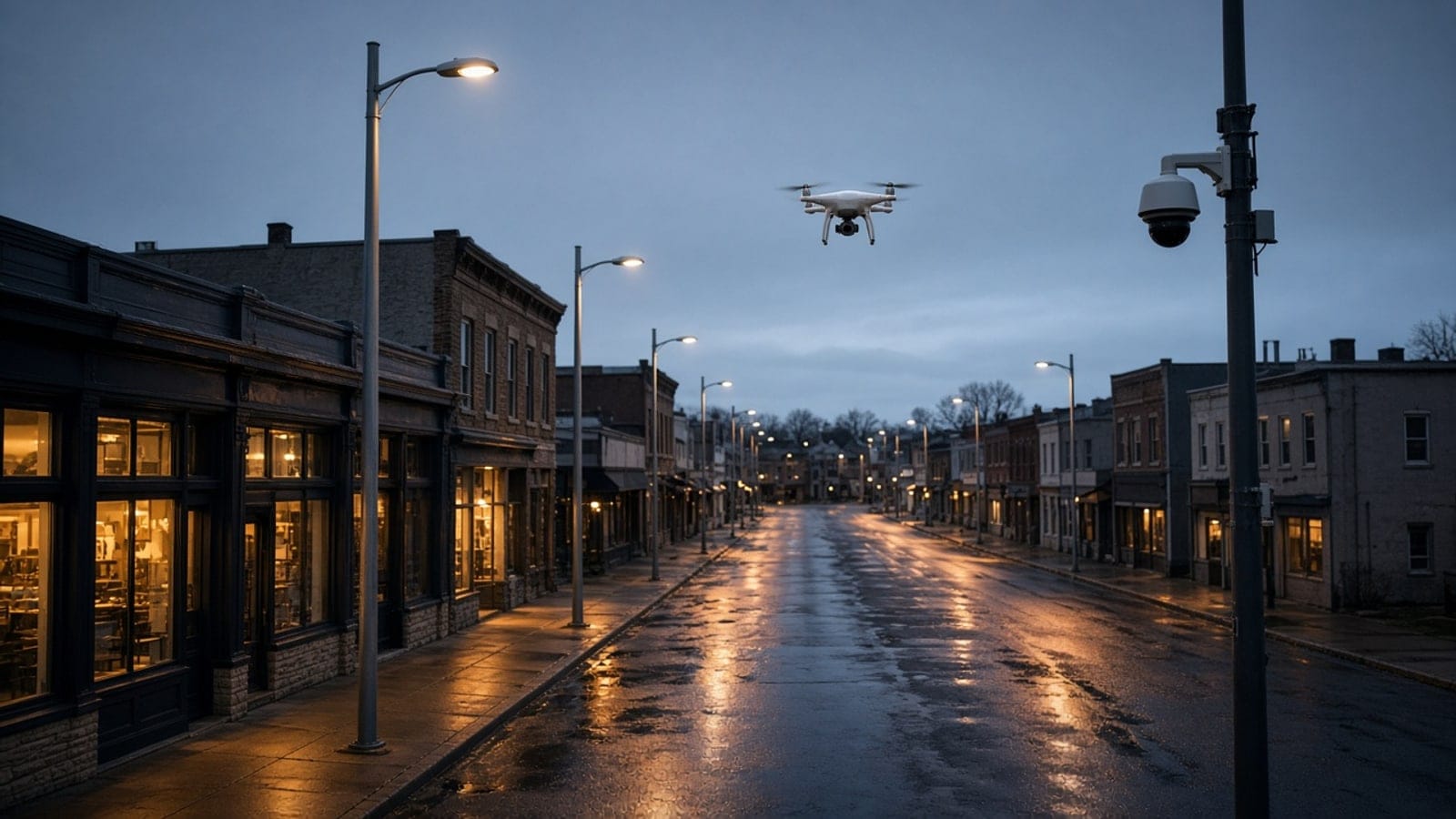
AI is increasingly wired into the physical fabric of cities and operations. Google’s Project Green Light uses AI and Google Maps driving data to recommend traffic-signal timing changes to city engineers; from 2022 through 2025 it had shared recommendations for roughly 540 intersections globally — about 420 added in 2025 alone — at intersections crossed by an estimated 220 million vehicles a month, with the company estimating over 13,000 tonnes of CO2-equivalent reductions in 2025. Smart-camera networks, AI-driven building-management systems, and autonomous drones for delivery and infrastructure inspection are spreading equally fast, each giving AI a set of eyes and, increasingly, a body.
The pattern across all of these deployments is the same: intelligence that once lived in a data center now perceives and acts in a town, a campus or a building. That makes a simple question central for every civilian operator — who owns that intelligence, and on whose terms does it run? Safeera’s founder puts it plainly: AI is safe as long as we, as people, believe in equality and choose peace over dominance. Infrastructure intelligence that belongs to the community it serves, rather than to a distant provider, is that belief expressed in hardware.
Governments have noticed. In 2025, CISA, the NSA, and the FBI, together with cybersecurity agencies from Australia, Canada, Germany, the Netherlands, New Zealand, and the UK, published “Principles for the Secure Integration of AI in Operational Technology.” Its four principles emphasize understanding AI risk, assessing data security in OT environments, establishing governance, and — tellingly — building in human oversight and fail-safes so that AI can “fail gracefully without disrupting critical operations.” The guidance is, in effect, an official argument for keeping AI control loops auditable and under human command.
That argument leads straight to local, owner-controlled compute. A traffic system, a building’s HVAC and access control, a fleet of inspection drones, or a campus camera network are all operational-technology systems where a cloud outage, a latency spike, or an external compromise can have physical consequences. Running their AI control core on-premises keeps the decision loop inside the operator’s own network, keeps sensitive video and building data out of third-party clouds, and — most importantly — keeps a real, physical off switch in the operator’s hand.
Safeera’s Centurion (for campuses, industrial facilities, and municipal deployments) and Sparks (for smaller sites and single buildings) are designed to be exactly that core: a physically bounded, auditable, switch-off-able compute appliance that a city or facility owns outright. As AI acquires more eyes, wheels, and actuators, the safest architecture is the one Safeera is built around — the intelligence that touches the physical world should live on hardware its owner controls.