The modern hospital is already a robotics environment. Intuitive Surgical’s da Vinci platform has performed millions of procedures worldwide over two decades, and its fifth generation, da Vinci 5, added force feedback and more onboard computing; in 2026 it secured expanded FDA clearances including cardiac procedures. After twenty years of near-monopoly, Intuitive now has serious rivals: Medtronic’s Hugo won FDA clearance for urologic procedures in late 2025, and Johnson & Johnson’s Ottava — which builds four arms into the operating table — completed its first U.S. clinical cases in April 2025 and won FDA authorization for general surgery in 2026. Smaller entrants including CMR Surgical (Versius), Distalmotion, and Moon Surgical are expanding the field, while orthopedic robots from Stryker (Mako) and Zimmer Biomet (ROSA) are now routine in joint replacement.
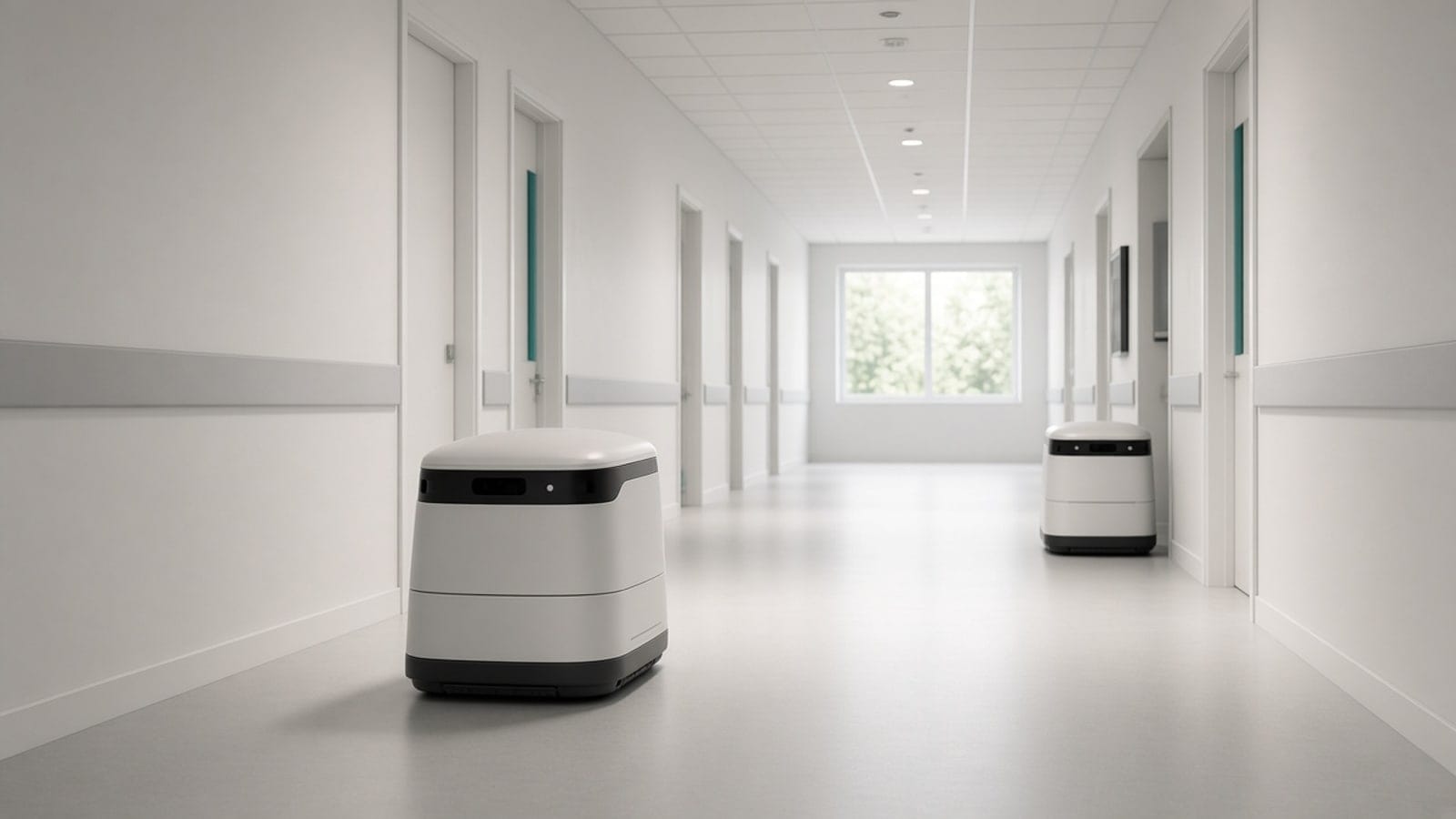
Beyond the operating room, logistics robots have quietly become infrastructure. Diligent Robotics’ Moxi navigates hospital hallways delivering medications, lab samples, and supplies; per a January 2026 Serve Robotics announcement, Moxi had completed “over 1.25 million deliveries… by nearly 100 robots in over 25 hospital facilities,” with Serve acquiring Diligent that month. Its Moxi 2.0 platform runs an onboard “robotic world model” on upgraded onboard compute that processes the environment 10–15 times faster than the prior generation. Aethon’s TUG and Relay Robotics fill similar delivery roles, and autonomous UV-disinfection and pharmacy-dispensing robots are widespread. The stated benefit is concrete: Diligent cites nurses spending up to 30% of their time on non-clinical tasks that a robot can absorb.
Rehabilitation and mobility robotics are advancing too. Wandercraft’s self-balancing exoskeletons (its Atalante personal exoskeleton was FDA-cleared in 2024) help paralyzed patients stand and walk; Ekso Bionics and Lifeward (formerly ReWalk) serve similar roles; and Fourier builds both rehabilitation and humanoid systems. Caregiving and eldercare robots from Toyota, Labrador Systems, and others are in trials, and general-purpose humanoids from Figure, 1X, Agibot, UBTech, and Unitree are beginning early pilots in care and service settings — though hospital use of humanoids remains experimental as of 2026.
The benefits are real but so are the risks. Robotic surgery outcomes depend heavily on training and case selection; logistics and humanoid robots raise questions of physical safety, liability, workforce displacement, and — critically — cybersecurity. A hospital robot is a networked device with cameras and physical actuators inside a space full of vulnerable people and protected health information. When such a device offloads its heavy perception and planning to a distant cloud, the hospital loses custody of both the data and the decision loop.
That is why a hospital wants one private, auditable, switch-off-able compute core on its own premises. HIPAA obligations are easiest to meet when patient data never leaves the building; latency-critical safety decisions should not depend on an internet link; and human-in-the-loop oversight is only meaningful if the humans control the machine that is doing the inference. Safeera’s Centurion — a roughly 100–120 kW module that installs on a rooftop or stands as a free-standing sculpture on the grounds, shipping on B300 Blackwell Ultra GPUs with an announced upgrade path to Vera Rubin — is designed to be that core: the shared, physically bounded cortex a hospital’s fleet of robots and clinical AI can rely on, owned and controllable by the institution itself.