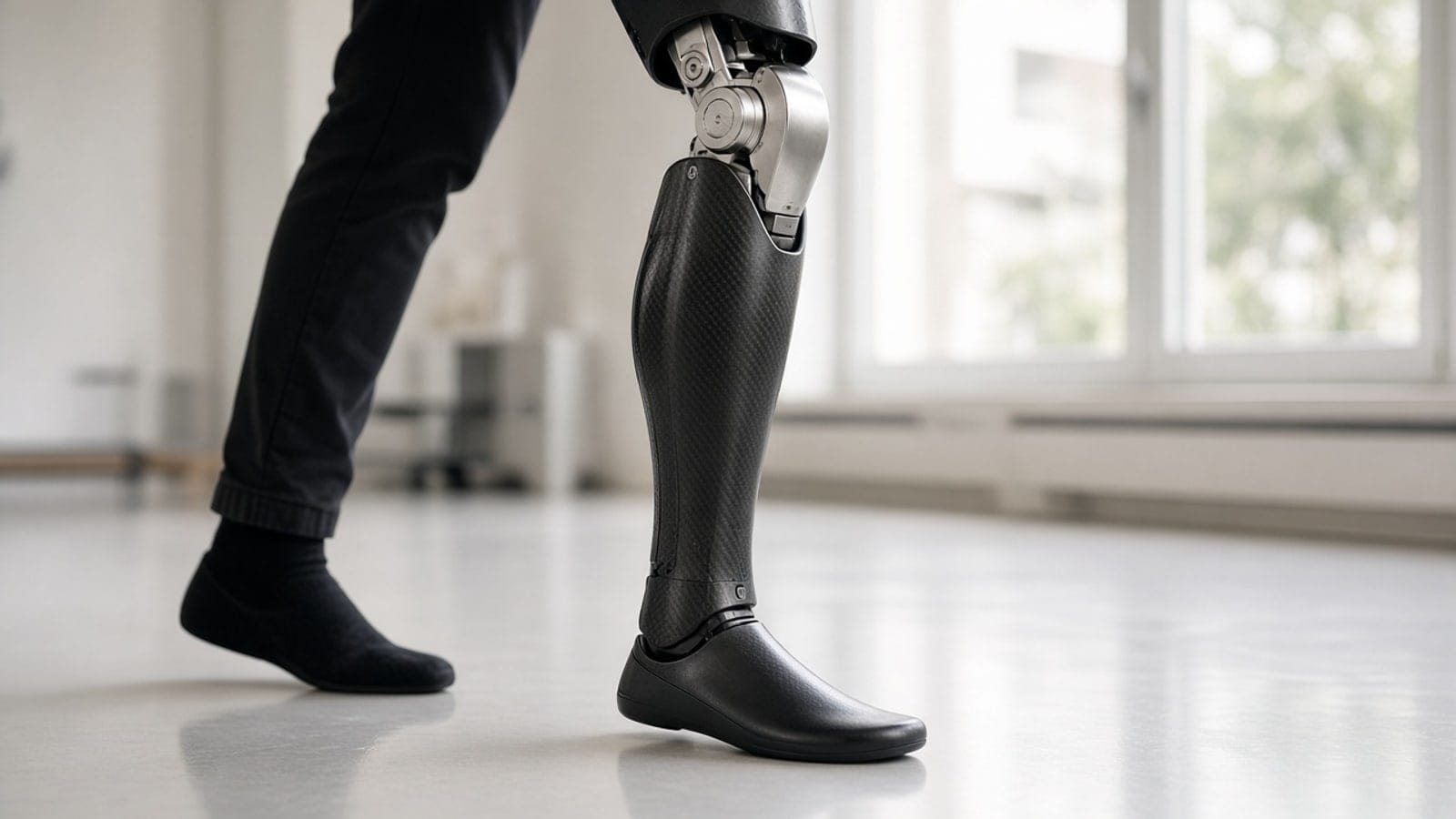
Prosthetics have crossed a threshold. In 2024, MIT’s Hugh Herr and colleagues reported in Nature Medicine a bionic leg controlled by the body’s own nervous system, built on the agonist-antagonist myoneural interface (AMI) — a surgical technique that reconnects muscle pairs so they still signal to each other. In 2025 the team combined AMI with a bone-anchored (osseointegrated) prosthesis, letting users feel and volitionally control the limb; per MIT News, “about 60 patients around the world have received this type of surgery, which can also be done for people with arm amputations.” The lesson is the same as in brain-computer interfaces: the mechanical limb is only as good as the model that translates the user’s residual muscle and nerve signals into motion.
The commercial and research field is broad. Össur’s bionic Power Knee and Ottobock’s microprocessor limbs lead the established market; Psyonic’s Ability Hand and Open Bionics’ Hero Arm bring affordable multi-articulating hands; Atom Limbs and Esper Bionics push next-generation arms; and Coapt commercializes pattern-recognition control that learns a user’s muscle signatures. Integrum’s e-OPRA pioneered osseointegration with neural control, and Phantom Neuro is developing a muscle-level implant (Phantom X) to drive prostheses. On the mobility side, Wandercraft’s exoskeletons and Onward Medical’s spinal-cord work restore standing and walking, while Neuralink’s CONVOY study explores driving an assistive robotic arm directly from the cortex. University labs worldwide are racing on AI-driven prosthetic control.
What unites all of these is that the control model is intensely personal. No two amputations, nerve maps, or muscle-signal patterns are alike, so a decoder trained for one person is nearly useless for another. Worse, the signals drift: swelling, fatigue, electrode shift, skin condition, and muscle adaptation all change the mapping over days and weeks. A prosthesis that felt natural last month can feel clumsy today unless its model is retrained on fresh data from its user.
That retraining is data-hungry and privacy-sensitive. It involves continuous recordings of a person’s neuromuscular activity — biometric data as intimate as it gets — and it must be available on demand, because a limb that only works when the cloud is reachable is not a limb a person can live on. Pattern-recognition and deep-learning controllers benefit enormously from overnight retraining on the day’s usage, and from low-latency inference measured in milliseconds, not round-trips to a data center.
A home compute core makes that private and always available. Safeera’s Googie gives a prosthesis or exoskeleton user a quiet, liquid-cooled, GPU-dense appliance to retrain their control model nightly on their own data, run it locally with minimal latency, and keep every recording under their own roof and their own control. As bionic limbs, exoskeletons, and neural interfaces converge, the personal model that drives them deserves a permanent, owner-controlled home — not a rented seat in someone else’s cloud.