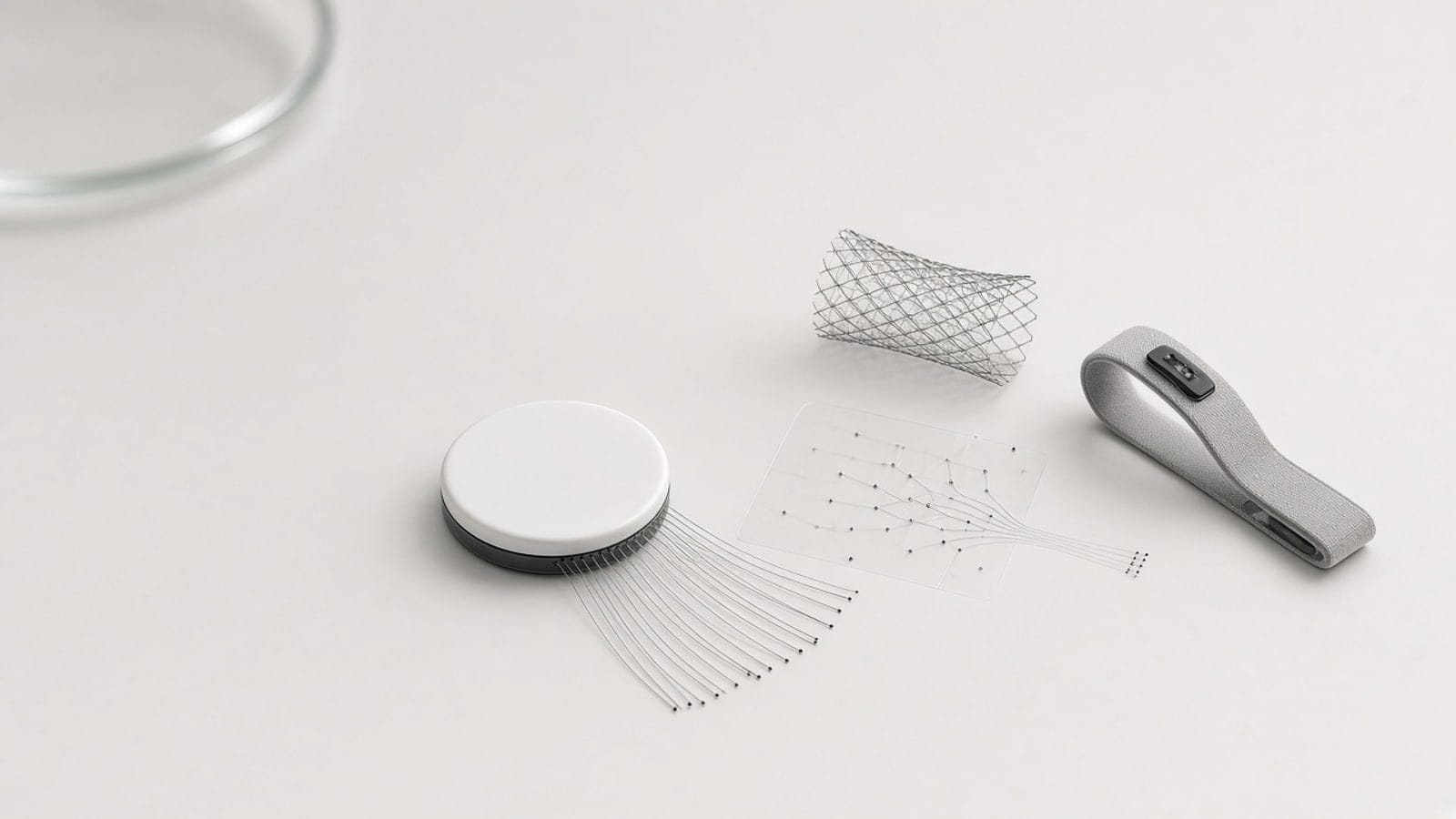
Neuralink is the loudest name in brain-computer interfaces, but it is one of many. Synchron takes a minimally invasive path: its Stentrode is delivered through a blood vessel like a stent, carrying 16 electrodes rather than penetrating the cortex. Synchron built its decoding on an edge-computing platform, unveiled a cognition foundation model called Chiral, became the first BCI to integrate with Apple’s new BCI Human Interface Device protocol (2025), and raised a $200 million Series D in November 2025 to fund a pivotal trial — the field’s first run at FDA premarket approval. Precision Neuroscience won FDA 510(k) clearance in April 2025 for its Layer 7 cortical interface (1,024 electrodes on a film one-fifth the thickness of a hair) for use up to 30 days, and has tested it in dozens of patients. Paradromics implanted its high-bandwidth Connexus in a human for the first time in 2025.
The list runs deep. Blackrock Neurotech holds the longest human track record via the Utah array and its MoveAgain system. Onward Medical pairs its ARC-BCI with the CEA-Clinatec WIMAGINE implant for spinal-cord injury. Science Corporation, led by Neuralink co-founder Max Hodak, published NEJM results in October 2025 for its PRIMA subretinal implant: of 38 participants with geographic atrophy from age-related macular degeneration, 32 reached the 12-month endpoint, and 26 (81.3%) achieved an improved prosthetic visual acuity of at least logMAR 0.2 versus baseline (p<0.001); the device is under European and FDA review. Merge Labs — co-founded by Sam Altman and backed by OpenAI — came out of stealth in January 2026 with a $250 million seed round at an $850 million valuation, pursuing a non-invasive, ultrasound-and-molecular approach. Forest Neurotech and Nudge explore ultrasound; Axoft builds soft implants; INBRAIN Neuroelectronics pioneered graphene electrodes with first human use in 2024; Motif Neurotech targets depression with a minimally invasive stimulator.
The race is global. In China, a state-designated “future industry,” NeuroXess reportedly completed more than 50 flexible-implant procedures by mid-2025; StairMed implanted its WRS01 microwire system in an amputee in March 2025; and Neuracle’s Beinao devices reached patients, with China becoming the first country to grant commercial marketing authorization for an invasive BCI. Non-invasive and wearable players — Kernel, Neurable, Emotiv, OpenBCI, Cognixion, Bitbrain — round out the consumer and clinical edges, while Phantom Neuro works at the muscle level and Integrum advances osseointegrated interfaces. Meta’s surface-EMG neural wristband, published in Nature in July 2025 and shipped as the Meta Neural Band with the Ray-Ban Display glasses, decodes hand gestures and handwriting from the wrist without any implant — and, Meta stresses, senses muscle signals at the periphery, not the brain.
Academia remains the substrate. The BrainGate consortium (Brown, Massachusetts General, and partners) supports much of the human work; the UCSF/Chang lab and UC Berkeley demonstrated real-time brain-to-voice synthesis; and in June 2025 UC Davis researchers, publishing in Nature, restored real-time synthesized speech to a man with ALS using 256 microelectrodes, with listeners transcribing sentences at over 94% accuracy in matching tests. Every one of these systems, invasive or not, shares one architecture: sensors capture signals, and machine-learning decoders turn them into intent.
| Company | Approach | Invasiveness | Status (2026) | Notable 2025–26 milestone |
|---|---|---|---|---|
| Neuralink | Penetrating threads, 1,024 ch | High | Investigational, multi-country | $650M Series E; ~21 enrolled |
| Synchron | Endovascular Stentrode, 16 ch | Low | Investigational | Apple BCI-HID; $200M Series D |
| Precision Neuro | Thin-film cortical array | Moderate | FDA 510(k) cleared (≤30 days) | Clearance April 2025 |
| Paradromics | High-bandwidth Connexus | High | Investigational (IDE) | First human implant 2025 |
| Blackrock Neurotech | Utah array | High | Longest track record | MoveAgain commercialization |
| Science Corp | PRIMA subretinal | Moderate | NEJM data; EU/FDA review | 81.3% acuity gain, NEJM 2025 |
| Merge Labs | Ultrasound / molecular | Non-invasive (planned) | Seed-stage | $250M seed at $850M (2026) |
| Meta | Surface-EMG wristband | Non-invasive | Shipping | Nature 2025; Neural Band |
The common thread is also the common vulnerability: neural and neuromotor data is the most intimate data a person can generate, and the decoder that reads it is personal and drifting. Whether the signal comes from cortex, blood vessel, retina, or wrist, it needs continual, private retraining and low-latency inference. That is the case for owner-controlled local compute at the user’s home — the Safeera Googie thesis. The Googie lets a person keep custody of the data, the model, and the power switch, no matter whose implant is inside them.