Some of AI’s highest-value work happens where infrastructure is thinnest. In rural and mobile clinics, AI diagnostics are already saving lives: handheld AI ultrasound from Butterfly, Caption, and Exo guides untrained users to usable images, and Qure.ai’s qXR chest-X-ray software screens for tuberculosis at more than 2,600 sites across dozens of countries, evaluated by the WHO and deployed through Africa and Southeast Asia with support from global-health funders. These tools work best when they can run at the point of care, not after a scan is uploaded over a connection that may not exist.
Agriculture is being remade the same way. John Deere’s See & Spray uses onboard computer vision and deep learning to distinguish crops from weeds and spray only the weeds — the system runs entirely on the machine without needing the cloud, and Deere says it “can reduce non-residual herbicide use by more than two-thirds by target spraying weeds.” Carbon Robotics’ LaserWeeder uses onboard cameras, AI perception, and lasers to kill weeds without chemicals, cutting weed-control costs sharply, with a lighter, faster G2 model introduced in 2025. Autonomous and electric tractors from Monarch and software from Agtonomy (working through OEMs like Kubota) bring driver-optional automation to farms — though the sector is volatile, and Monarch itself warned of financial distress in late 2025. All of this compute has to run in a field.
The constraint that ties these together is power and connectivity. Remote mining and energy sites, disaster-response operations, humanitarian deployments, and scientific research stations all need to process data — imagery, sensor streams, models — where the grid is weak or absent and the cloud is a satellite hop away. At the same time, the broader AI build-out is running into a genuine electricity shortage, making grid-dependent compute an unreliable foundation in exactly the places that need help most.
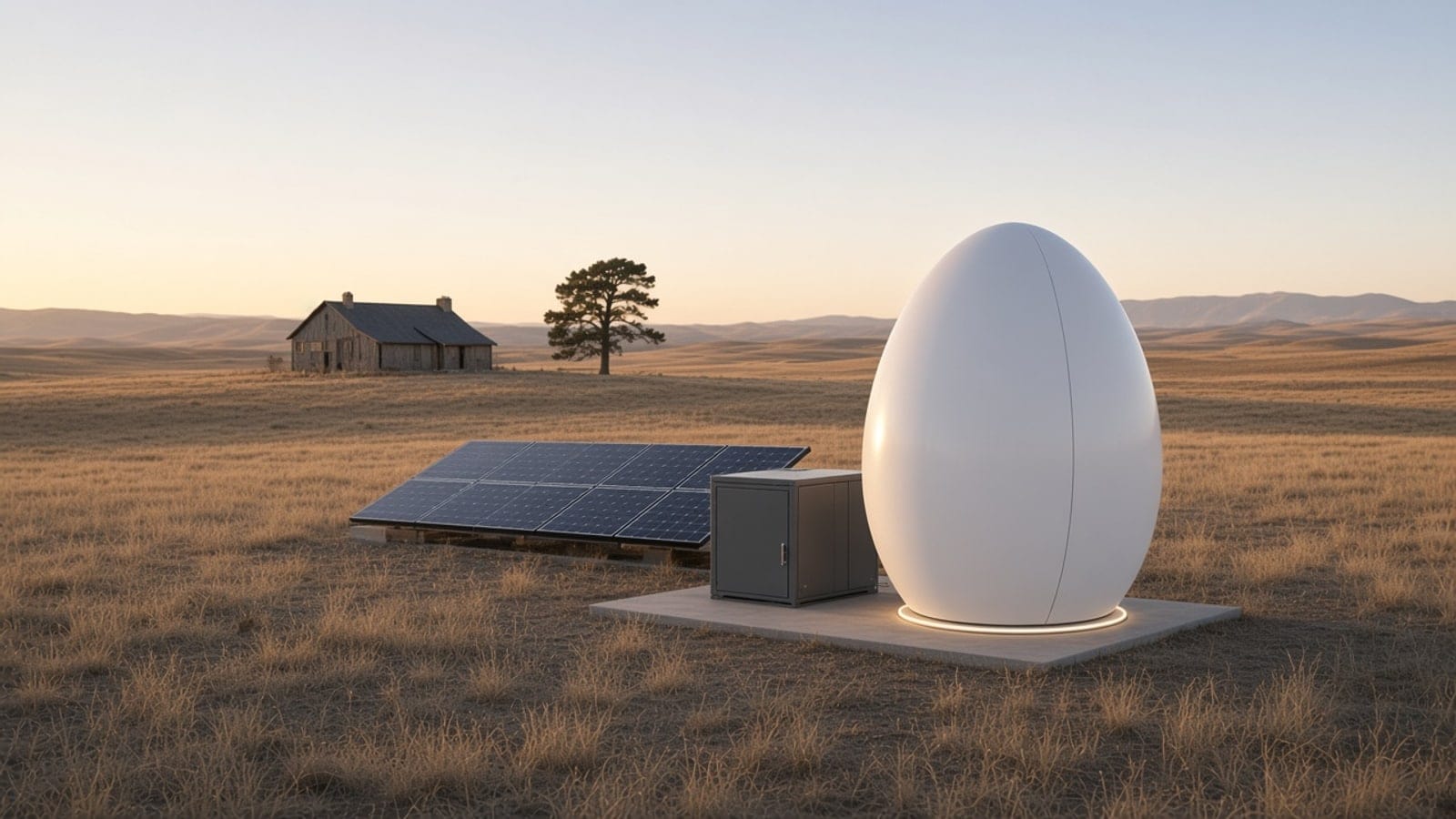
The honest engineering answer is a compute appliance that can carry its own energy. That is the design of Safeera’s Sparks: sixteen B300 Blackwell Ultra GPUs at roughly 32 kW, shipped as a self-contained enclosure, with an optional solar array, battery, and backup generator. It lets a rural clinic run diagnostic models, a farm run vision-guided autonomy, or a field team run analysis on-site — with data custody and the off switch staying local.
Realism matters, and Safeera states it plainly: the optional array is sized to offset a year’s electricity under net metering, not to carry a continuous 32 kW load through the night or poor weather, so off the grid the battery and the generator are required parts of the power option, not extras. The Sparks is not a claim that sunlight alone powers frontier AI; with the power option it is an integrated power-and-compute package designed so that intelligence can operate where the grid and the cloud do not reach — bringing capable, owner-controlled AI to the edge of the map.