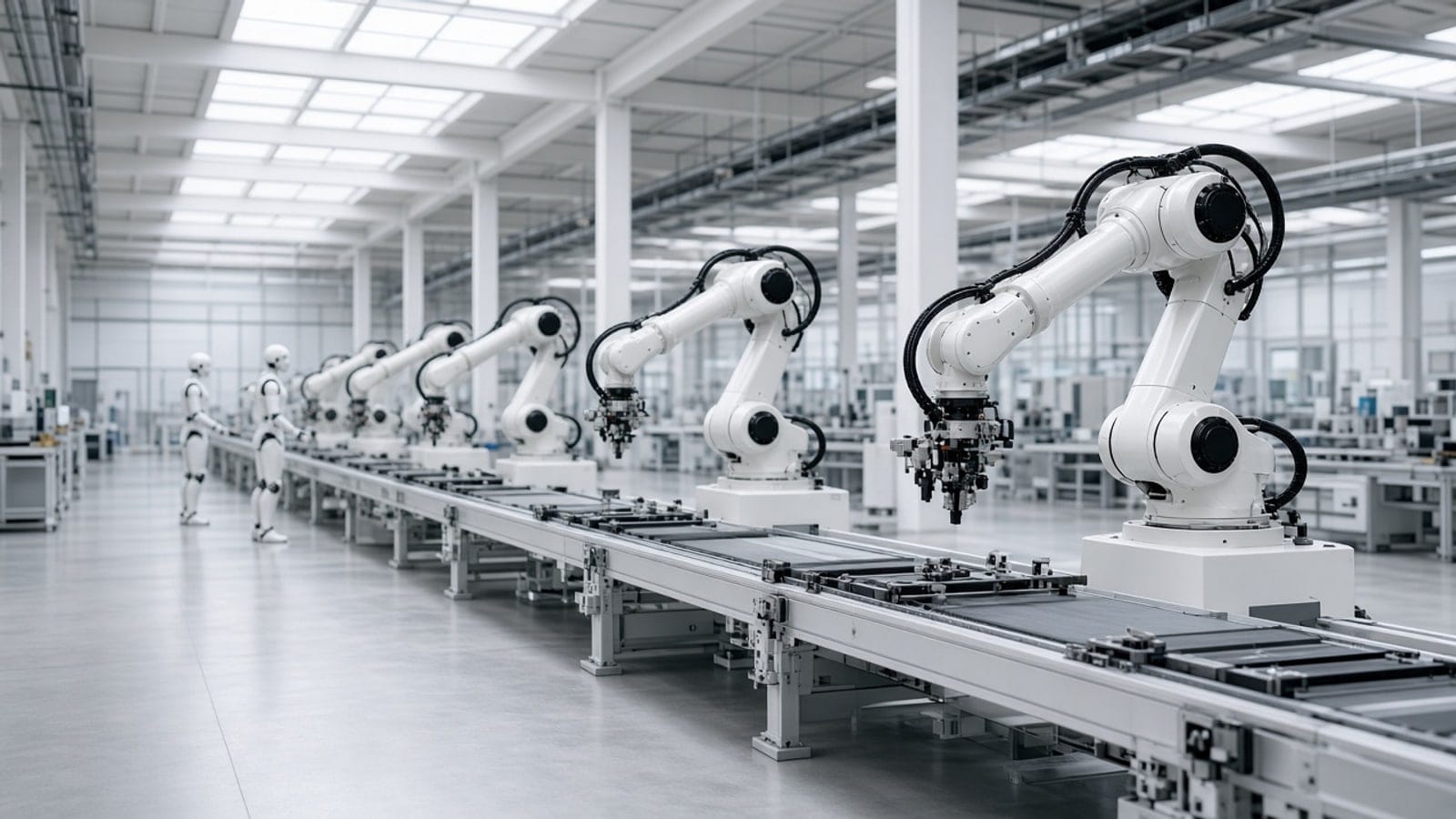
Physical AI has left the demo reel and entered the plant. Figure says it had delivered more than 350 of its Figure 03 humanoids by spring 2026 and reported production-floor metrics from BMW’s Spartanburg plant — thousands of runtime hours and tens of thousands of parts handled — under a robots-as-a-service arrangement. Agility Robotics’ Digit works in logistics for customers including GXO and Schaeffler and is built at the company’s RoboFab facility. Apptronik’s Apollo is deployed with Mercedes-Benz (integrated into the MO360 production system), GXO, and Jabil, backed by an oversubscribed Series A that grew past $400 million with Mercedes and Google among investors. These are pilots and early commercial placements, not mass deployment — but they are real.
The field is crowded and fast-moving. Tesla’s Optimus remains an internal-factory project not yet sold commercially, with production timelines repeatedly pushed. Boston Dynamics unveiled commercial production of its electric Atlas at CES 2026, with initial units committed to Hyundai’s manufacturing facilities and Google DeepMind. China’s humanoid makers are scaling aggressively: UBTech’s Walker S is in trials at BYD, Foxconn, Geely, and Zeekr plants, with the founder describing over 500 units of intended orders, while Unitree, AgiBot, Fourier, Xpeng (Iron), and Galbot push their own platforms. Sanctuary AI and 1X add to the Western field. Underpinning many of them is a common robotics stack of foundation models, simulation and onboard compute, while Foxconn and Siemens build digital twins of the factories themselves.
The scale context is set by conventional automation: Amazon announced it had deployed more than 1 million robots across its fulfillment network by mid-2025 (the millionth delivered to a fulfillment center in Japan) and launched an AI foundation model, DeepFleet, which the company says “will coordinate the movement of robots across our fulfillment network, improving the travel time of our robotic fleet by 10%.” Market forecasts are bullish but wide-ranging: Goldman Sachs Research first projected a $38 billion humanoid market by 2035 (up more than sixfold from a prior $6 billion estimate, paired with a 1.4-million-unit shipment forecast), then revised upward to roughly 6.5 million units and about $138 billion by 2035; Morgan Stanley has sketched multi-trillion-dollar scenarios by 2050. These are projections, not facts, and worth treating with caution.
Here is the architectural insight that matters for buyers. A humanoid or mobile robot does not need to carry all of its intelligence on its back. Heavy perception, planning, and vision-language-action inference can be offloaded to a central cortex — one powerful on-premises compute core that an entire fleet shares over the local network, while each robot keeps only the fast, safety-critical reflexes onboard. This is cheaper per robot, easier to update, and — crucially — keeps the plant’s most sensitive assets in the plant.
Those assets are the reason owner-controlled, physically bounded compute matters. A factory’s process data, product designs, and line layouts are core intellectual property; a robot fleet’s control loop is a safety system. Sending either to an external cloud creates IP-leakage and availability risks that no CISA guidance would smile upon. Safeera’s Centurion gives a plant a 100–120 kW private inference core on its own footprint — the shared intelligence for a robot fleet, air-gapped from the public internet if the owner wishes and switch-off-able at will. For a small workshop or engineering shop running a robot or two, the Sparks — sixteen B300 Blackwell Ultra GPUs at roughly 32 kW, with optional solar, battery, and a backup generator — brings the same owner-controlled model to a far smaller footprint.